
High Ambient, High Altitude and Voltage Deviation: How Site Conditions Cut Delivered Air Flow
Site conditions change delivered air flow in three separate ways, and they need three separate corrections. Altitude removes air mass: above roughly 1,000 m you lose about 12 % of the inlet density for every further 1,000 m, so a machine catalogued at 10 m³/min delivers about 7.8 m³/min of real free air at 2,000 m with the gauge still reading 8 bar. Ambient temperature above 40 °C does not change the rotor displacement but does raise discharge temperature, halve oil life for every extra 10 K, and derate both the drive and the motor. Supply voltage outside ±5 % of nameplate moves current and winding temperature long before it trips anything. The mistake is to multiply all three factors into one oversized machine; the correct method is to correct flow for density, then check thermal and electrical margins separately on the components they actually affect.
Altitude: the air gets thinner, the rotors do not
A fixed-speed screw compressor is a displacement machine. Each revolution traps the same volume between the rotors, so the volume flow at the inlet is set by geometry and speed and barely moves with altitude. What changes is the mass of that volume. At 2,000 m a cubic metre of ambient air weighs about 22 % less than at sea level, so the same inlet volume carries 22 % fewer kilograms of air into the process. Gauges read pressure, not mass, which is why an altitude problem is so often mistaken for a capacity problem.
| Altitude | Barometric pressure | Density vs sea level | Free air delivered (share of catalogue value) |
|---|---|---|---|
| 0 m | 101.3 kPa | 1.00 | 100 % |
| 500 m | 95.5 kPa | 0.94 | 94 % |
| 1,000 m | 89.9 kPa | 0.89 | 89 % |
| 1,500 m | 84.6 kPa | 0.83 | 83 % |
| 2,000 m | 79.5 kPa | 0.78 | 78 % |
| 2,500 m | 74.7 kPa | 0.74 | 74 % |
| 3,000 m | 70.1 kPa | 0.69 | 69 % |
Two consequences follow, and they pull in opposite directions. First, air-consuming equipment rated in normal litres or standard cubic feet will be short of mass, so cylinders get slower and blow-off is weaker even though the header pressure looks correct; the demand has to be recalculated in mass terms, not read off the old nameplate. Second, the compressor motor is now doing less work per cubic metre, because compression work scales with mass too. That means the motor is usually not the limiting component at altitude, while the cooler and the motor cooling air flow very much are: thinner air removes less heat per cubic metre of fan flow, so the approach temperature of an air-cooled cooler widens by several kelvin and the discharge temperature climbs.
High ambient: the limit is temperature, not flow
Catalogue figures are quoted at standard inlet conditions, typically 20 °C and 1 bar absolute. Running the same machine on 45 °C inlet air costs roughly 8 % of the mass flow before any thermal effect is considered, because the inlet density falls with absolute temperature. The larger effect is thermal. Oil oxidation roughly doubles for every 10 K above about 80 °C, so a machine that sits at 95 °C on a mild day is already burning through its lubricant twice as fast as one at 85 °C, and the same oil is what seals, cools and carries the wear particles out of the compression chamber.
| Ambient at the intake | Typical effect | What to check before ordering |
|---|---|---|
| Up to 40 °C | Standard rating conditions; no correction needed | Cooler approach and ventilation, as in any install |
| 40–45 °C | Discharge +5 to 10 K; oil life roughly halved per +10 K | Cooler size, oil change interval, cabinet ventilation |
| 45–50 °C | Discharge +10 to 18 K; VSD cabinet at or beyond its rating | Water-cooled option, oversized cooler, remote cabinet, oil type |
| Above 50 °C | Outside normal air-cooled practice for standard packages | Special cooling package, heat recovery, or relocate the intake |
The intake is the cheapest lever available. A duct that draws from the shaded north side, from under a canopy, or from an adjacent cooler space can hand the machine air 8–12 K below the afternoon peak, which buys back most of the thermal derate for the price of sheet metal. Anything that recirculates hot discharge air back to the intake removes that gain completely, which is why room ventilation belongs in the design rather than in the after-the-fact complaint list; the ducting and clearance rules are set out in the compressor room layout and pressure drop guide.
Drying deserves the same attention, because a hotter inlet means a wetter system at the same pressure dew point margin. Refrigerated dryers are rated at a fixed inlet temperature and lose capacity quickly above it, so a site running at 45 °C ambient needs the dew point requirement re-derived rather than copied from the temperate-zone datasheet — the method is in dryer selection by pressure dew point.
Voltage deviation: current and heat, long before a trip
Induction motors tolerate a steady-state voltage band of ±5 % around nameplate for continuous duty, and up to ±10 % only with measurable life penalty; that is the envelope in IEC 60034-1, and it assumes a balanced supply. Torque falls with the square of voltage, so at 90 % voltage the breakaway torque is down to about 81 % and the full-load current rises by roughly 15–20 % to deliver the same shaft power. Winding temperature rise follows the current, and an extra 20–25 K of rise costs roughly half the insulation life by the classic 10 K rule.
| Voltage unbalance (phase to phase) | Indicative motor derating factor | What it looks like on site |
|---|---|---|
| 1 % | 0.98 | Invisible on a panel meter; already costing temperature rise |
| 2 % | 0.95 | One phase consistently warmer at the terminal box |
| 3 % | 0.88 | Frequent overload trips on hot afternoons only |
| 4 % | 0.82 | Short motor life; nothing else in the plant explains it |
| 5 % | 0.75 | Not acceptable for continuous duty |
Variable-speed units have a different failure mode at the same cause. The drive rectifies the incoming supply, so a sustained 15 % undervoltage collapses the DC bus and produces an undervoltage trip that looks like a drive fault and is nothing of the kind. Long cable runs, a transformer tap set for a different feeder, and a generator-backed supply all produce the same symptom. Where the supply is weak or unstable, sizing the drive for the actual voltage window and setting the transformer tap on site is part of commissioning, not an optional refinement. For the load-side view of the same equipment, see how partial-load VSD savings are calculated.
Combining the three corrections without over-buying
The three effects touch different components, so they must not simply be multiplied into one oversize factor. Density correction reduces delivered flow; ambient and altitude together set the thermal duty of the cooler, the oil and the motor; voltage quality sets the electrical duty of the motor and the drive. A machine chosen on a single combined factor is usually too large, which leaves it short-cycling at part load for the rest of its life — the opposite of the saving the correction was meant to buy.
- Step 1 — restate demand as mass flow at site conditions, in m³/min or Nm³/min, not as the figure copied from a catalogue.
- Step 2 — divide by the density ratio for the site altitude to get the volume the machine must sweep at the intake.
- Step 3 — check the cooler, oil and motor against the site ambient, including the cabinet for a variable-speed drive.
- Step 4 — check the motor and drive against the measured voltage window and unbalance, not the nominal figure on the utility bill.
- Step 5 — re-check the part-load behaviour, because a machine that is oversized for altitude will spend its life in the least efficient region of its curve.
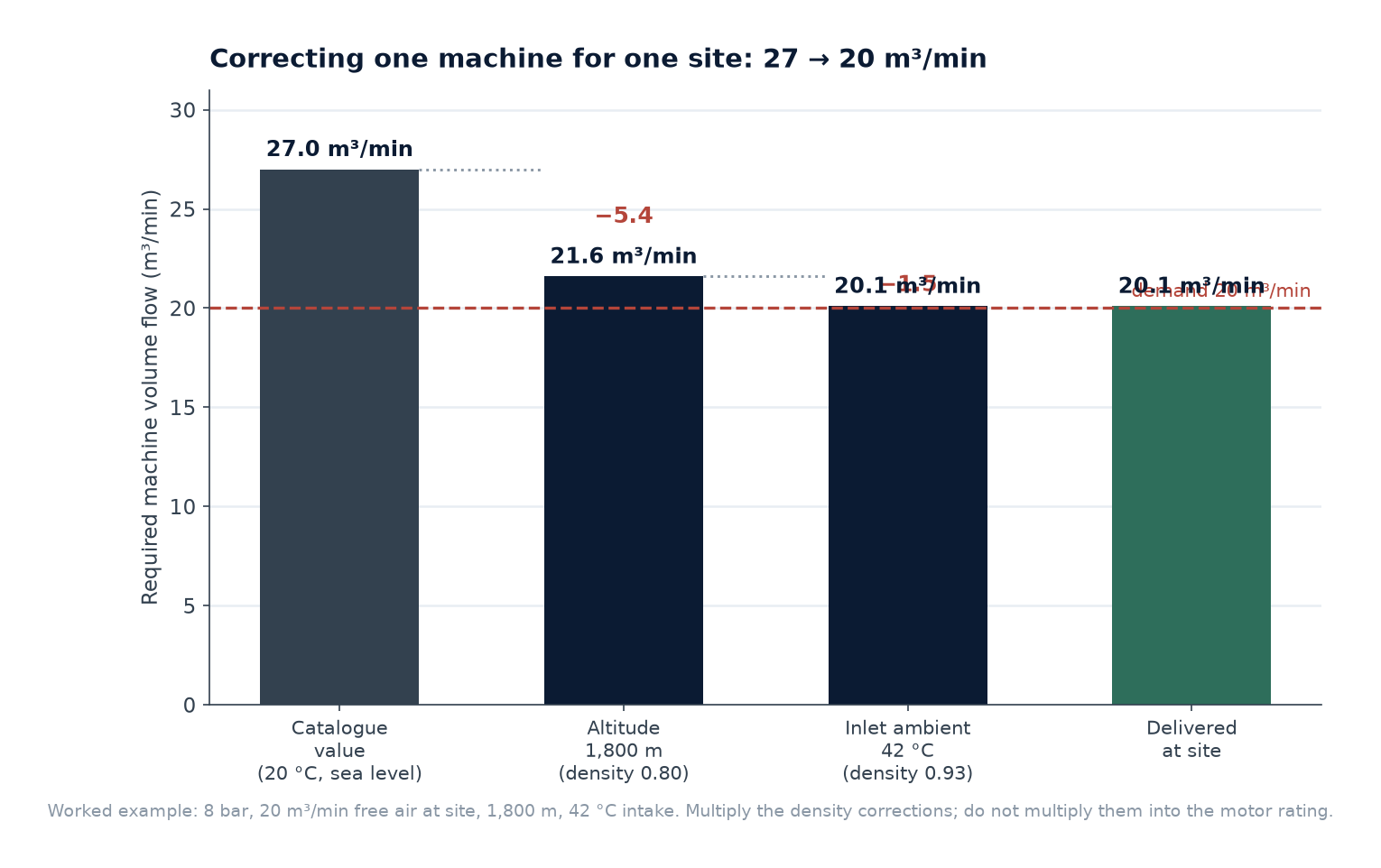
A worked case makes the arithmetic concrete. A plant at 1,800 m, with 42 °C summer ambient and a demand of 20 m³/min of free air at 8 bar: the density ratio is about 0.80, so the machine must deliver 25 m³/min at its own intake to put 20 m³/min of real air into the tools. Of that, the 20 °C-to-42 °C inlet difference accounts for roughly another 7 %, bringing the catalogue figure to about 27 m³/min. The motor does not need that 27 m³/min of shaft power margin, but the cooler does need to be sized for it, and the oil change interval needs to assume a 42 °C ambient rather than the 20 °C used in the maintenance table. Where a site is this far from standard conditions, ordering from a standard catalogue without stating the site data is how a machine ends up considered underpowered when it is merely misapplied — the packaged solution in units engineered for extreme conditions exists exactly for this case.
Site survey before the specification is fixed
- Altitude of the installation, not of the nearest town — a plant on a plateau can be 300 m above its own access road.
- Maximum ambient at the intake, with the recirculation question answered: where does the hot air go?
- Voltage measured under load at the compressor terminals, phase to phase, three readings over a working day, plus unbalance.
- Supply frequency and its stability, and whether a generator carries the load during outages.
- Dust, humidity and salt, because all three change the cleaning and corrosion assumptions behind the thermal margins.
- Cooling water availability and temperature if a water-cooled unit is being considered.
Frequently asked questions
Can I just size for the highest altitude year-round?
Only if the altitude is the same all year, which it is; altitude does not vary. The mistake is applying the same treatment to ambient temperature, which varies daily and seasonally. Correct flow permanently for altitude, and correct thermal margins for the worst sustained ambient, not for a five-day heat wave.
Does altitude matter below 1,000 m?
It starts to matter at roughly 1,000 m for capacity calculations, where the loss is about 11 %, and earlier for air-cooled packages with marginal ventilation. Below 500 m the correction is inside the measurement tolerance of most site instruments.
Is a variable-speed drive the answer to voltage swings?
Partly. A drive tolerates a wide input window and keeps the motor at its correct V/Hz ratio, so it protects the machine from the supply. It cannot protect itself: sustained undervoltage collapses the DC bus and trips. Fix the supply first, then use the drive for part-load efficiency.
Why does my machine not reach nameplate flow at high ambient?
Because the nameplate was measured at standard inlet conditions. Inlet density falls with absolute temperature, so mass flow and therefore delivered free air fall with it, while the discharge pressure is unchanged. The machine is behaving correctly.
What oil change interval should a hot site assume?
Interval is set by oxidation, and oxidation roughly doubles per 10 K above about 80 °C. Rather than halving the calendar interval blindly, sample the oil: viscosity, acid number and oxidation trend tell you where the site actually stands, and a single sampling programme usually pays for itself in avoided change-outs.
Answers apply to oil-flooded rotary screw installations with standard filtration; site-specific limits always come from the manual of the unit supplied and from the process standard for the application.
Sizing a machine for a site that is not at sea level
Send the site altitude, the highest sustained ambient at the intake, the measured voltage window and the required free air delivered, and the selection can be reworked against those conditions instead of the catalogue standard.