
Refrigerated or Desiccant Air Dryer? Choose by Pressure Dew Point
Start from the pressure dew point the process needs, then work back to the dryer. Indoor workshop air feeding pneumatic tools and paint lines through indoor piping: a refrigerated dryer holding +3 °C is enough. Any line that can see below +3 °C — outdoor runs, unheated warehouses, cold climates — or any instrument-air duty: a desiccant dryer at −20 °C or −40 °C pressure dew point. Below −40 °C you are buying a real capability and paying for it in compressed air, because most desiccant dryers regenerate with 15–20 % of the air they dry.
Pressure dew point is not atmospheric dew point
The single most common specification error in air treatment is a dryer quoted at “−40 °C dew point” when the figure refers to atmospheric pressure rather than to the air at line pressure. A gas at 8 bar absolute that is saturated at −40 °C holds the same mass of water as a gas at atmospheric pressure saturated at roughly −57 °C. The same water content, two very different numbers, and a buyer comparing the two quotes concludes that one dryer is far better than the other when they may be identical.
| Pressure dew point at 7 bar g | Roughly equivalent atmospheric dew point | ISO 8573-1 water class |
|---|---|---|
| +3 °C | −20 °C | Class 4 |
| −20 °C | −40 °C | Class 3 |
| −40 °C | −57 °C | Class 2 |
| −70 °C | −85 °C | Class 1 |
Always quote the pressure dew point, always state the pressure it applies to, and always confirm which convention the supplier used. ISO 8573-1 classes are defined on pressure dew point, so citing the class removes the ambiguity altogether — the class table above is the version worth writing into a purchase specification.
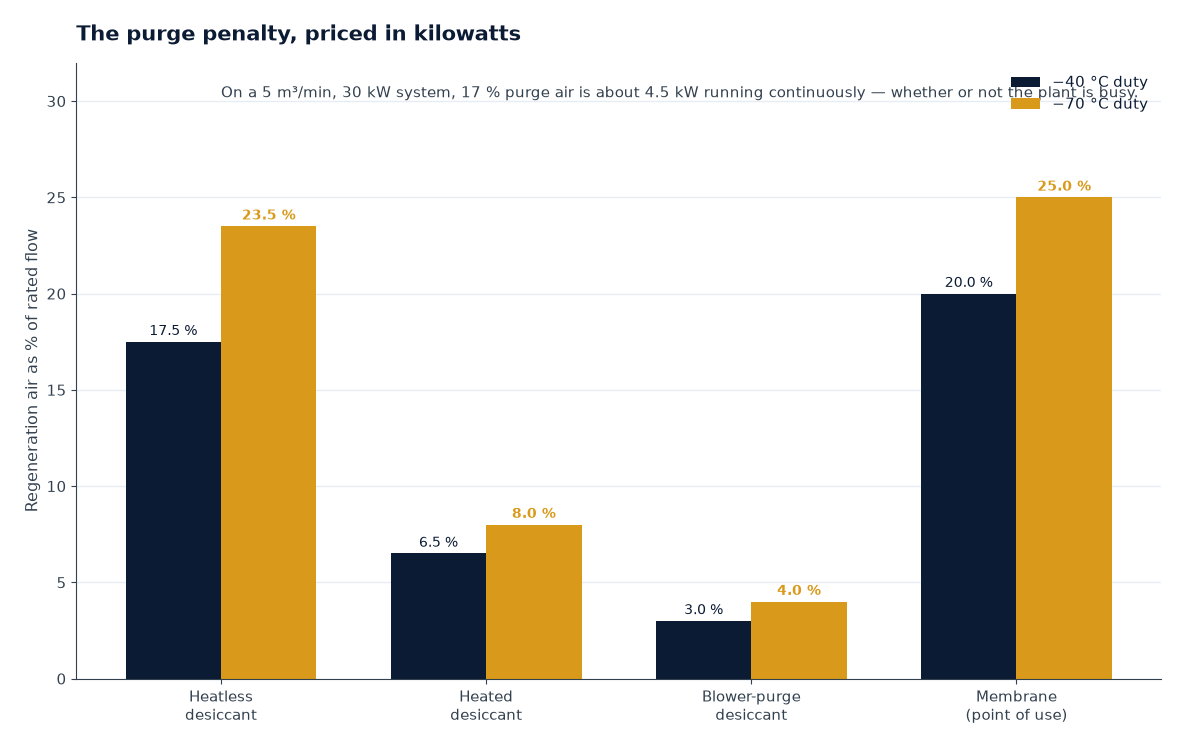
What each dryer family can actually hold
There are three families in practical use, and each has a floor below which it cannot go no matter how much is spent on it. Refrigerated drying is limited by the evaporator approach temperature: the refrigerant can be colder than +3 °C but the air leaving the dryer cannot, or the condensate would freeze on the coil.
| Type | Typical pressure dew point | Regeneration / purge air | Where it fits |
|---|---|---|---|
| Refrigerated (cycling or non-cycling) | +3 to +10 °C | None | General plant air, indoor piping, tools, most paint and blast duties |
| Heatless desiccant | −40 °C standard, −70 °C optional | 15–20 % of rated flow at −40 °C | Instrument air, outdoor lines, cold climates, laser assist gas |
| Heated or blower-purge desiccant | −40 to −70 °C | 3–8 % (plus heater or blower power) | Large flows needing −40 °C where purge air is expensive |
| Membrane | −20 to −40 °C | 15–25 % | Point-of-use, hazardous areas, low flows, no moving parts |
Two consequences follow. First, a refrigerated dryer cannot be pushed to −20 °C by adding refrigerant capacity; the limit is physical. Second, once the requirement goes below −40 °C the purge air becomes the dominant operating consideration, not the dryer itself.
Where the requirement actually comes from
Dew point specifications are often inherited from a previous plant or from a single critical machine, and then applied to the whole network. Separating the requirements by end use usually cuts the desiccant flow — and the purge penalty — by a large factor.
| Application | Sensible pressure dew point | Note |
|---|---|---|
| Pneumatic tools, cylinders, general workshop | +3 °C | Refrigerated dryer plus a coalescing filter; the pipe must stay above freezing |
| Paint spraying, blasting, powder coating | +3 °C | Dryness matters less than oil removal; a coalescing filter is the critical element |
| Outdoor or unheated piping, cold climate | −20 °C or below | The requirement is the coldest pipe wall temperature, not the process |
| General instrument air | −20 °C (Class 3) | Check the actuator and analyser datasheets rather than assuming −40 °C |
| Laser cutting assist gas | −40 °C (Class 2) | Moisture in the assist gas shows up as dross and lens contamination |
| Pharma, food contact, electronics | −40 to −70 °C (Class 2/1) | Usually specified by the process standard, not by the compressor supplier |
The useful question is not “what dew point can this dryer reach” but “what is the coldest temperature any part of my piping will reach, and what does the end device tolerate”. Answer that and the family chooses itself.
The purge air a desiccant dryer really costs
A heatless desiccant dryer works by stealing dry air from its own outlet to regenerate the off-stream vessel. At −40 °C, that is typically 15–20 % of the rated flow; at −70 °C it rises to 22–25 %. It is not a rounding error. On a 30 kW compressor delivering about 5 m³/min, a 15 % purge means roughly 0.75 m³/min — and about 4.5 kW — continuously dedicated to drying, whether or not the plant is busy.
| Dryer type at −40 °C | Purge / regeneration air | Continuous power tied up on a 5 m³/min, 30 kW system |
|---|---|---|
| Heatless desiccant | 15–20 % | ≈ 4.5–6 kW equivalent |
| Heated desiccant | 5–8 % | ≈ 1.5–2.4 kW plus heater load during regeneration |
| Blower purge desiccant | 2–4 % | Purge nearly eliminated, blower and heater draw instead |
| Membrane (point of use only) | 15–25 % | Acceptable at 0.5 m³/min, rarely at 5 m³/min |
This is why desiccant drying is specified for a small, well-defined flow — instrument air, a laser, an outdoor line — and rarely for a whole plant. Where the whole plant needs −40 °C, a heated or blower-purge machine, or a split architecture with a small desiccant dryer on the critical branch, usually beats a single large heatless unit. The load-following arithmetic is the same as for a variable-speed compressor at partial load: the auxiliary load matters as much as the main one.
Sizing corrections that are usually skipped
Dryers are rated at standard conditions — typically 7 bar, 38 °C inlet air and 38 °C ambient for a refrigerated unit. Those conditions are not what most plants have. A dryer selected on rated flow alone in a 45 °C room with a 45 °C inlet is effectively undersized, and the symptom is a dew point that drifts upward in the afternoon rather than a dryer that fails outright.
| Correction | Condition | Indicative factor |
|---|---|---|
| Inlet air temperature | 30 °C / 38 °C / 45 °C / 50 °C | 1.15 / 1.00 / 0.85 / 0.75 |
| Ambient temperature | 25 °C / 38 °C / 45 °C | 1.05 / 1.00 / 0.92 |
| Working pressure | 10 bar / 7 bar / 5 bar | 1.10 / 1.00 / 0.85 |
| Desiccant inlet at −40 °C | Any inlet temperature | No derating, but requires a coalescing pre-filter |
Apply the factors to the actual flow, not to the compressor nameplate: a dryer sized on the compressor rating is oversized most of the year and still short during the peaks that matter. Use the measured or calculated peak demand, then apply the corrections. Figures vary by manufacturer, so use their published table and treat the values above as the shape of the correction rather than a substitute for it.
When the answer is two dryers in series
Where the flow is large or the inlet is hot and humid, a refrigerated dryer ahead of a desiccant dryer is often the most economical arrangement: the refrigerated unit removes the bulk water and protects the desiccant from overload, and the desiccant unit then only has to finish the job. In hot climates this can halve the desiccant bed’s moisture load and cut purge consumption with it. The same logic applies to high-pressure duties, where the compression architecture itself changes the water load the dryer has to handle.
Installation details that decide the dew point you actually get
- Fit a coalescing pre-filter ahead of every desiccant dryer: oil aerosol poisons the desiccant permanently, and no amount of regeneration brings it back
- Provide a full-flow bypass around the dryer with isolation valves — a dryer that stops production when it needs service will be left in bypass for years
- Keep the refrigerated dryer out of the compressor’s hot air path and below its rated ambient; ambient derating shows up as a dew point, not as an alarm
- Drain the separator and the dryer properly, with a strainer and a visible discharge: a blocked trap sends water downstream whatever the dryer is doing
- Monitor the dew point at the dryer outlet, not at the header — the difference tells you whether the problem is the dryer or the piping
- Insulate cold pipework where ambient can drop below the pressure dew point, or the water will condense in the pipe you just dried the air for
Where the air feeds a high-pressure process, the dryer is part of a chain that includes the compressor stage arrangement and the filtration; a high-pressure compressor for laser cutting, for instance, is judged on the dew point at the nozzle, not at the dryer outlet.
A selection sequence that holds up
- 1. State the coldest pipe wall temperature and the end-device tolerance; convert to a pressure dew point and to an ISO 8573-1 class
- 2. Split the network: which branches genuinely need the low dew point — usually one or two
- 3. Size on measured or calculated peak flow, then apply inlet temperature, ambient and pressure corrections
- 4. Choose the family for each branch; add a refrigerated pre-dryer where the desiccant load is dominated by water rather than by the target dew point
- 5. Compare total operating effect — dryer power plus purge air expressed in kW — not dryer purchase alone; our partial-load calculation method applies unchanged to auxiliary loads
- 6. Specify dew point instrumentation at the outlet, and put the alarm where someone will see it
Dryer selection is usually an afterthought once the compressor is chosen, yet the dew point requirement shapes the whole train: pressure, filtration, pipe insulation and room layout. If both decisions are made together, the compressor range and the dryer can be matched to the duty instead of to each other’s brochure; if they are made separately, the dryer ends up oversized for most of the year and short during the peaks.
Frequently asked questions
What pressure dew point do I need for instrument air?
−20 °C (ISO 8573-1 class 3) covers most general instrument air, and −40 °C (class 2) is specified where the ambient or the piping can go colder or where the end device demands it. Check the actuator and analyser datasheets rather than defaulting to −40 °C; the difference between the two classes is usually the difference between a refrigerated dryer and a desiccant one, with the operating consequences that follow.
Can a refrigerated dryer reach −40 °C dew point?
No. A refrigerated dryer is limited by the evaporator approach temperature; the air leaving it cannot go much below +2 to +3 °C without freezing condensate on the coil. Dryers claiming lower figures are usually quoting atmospheric dew point, which for a +3 °C pressure dew point at 7 bar is about −20 °C. Anything genuinely below −20 °C requires a desiccant or membrane dryer.
How much air does a desiccant dryer waste?
A heatless desiccant dryer consumes roughly 15–20 % of its rated flow as purge air at −40 °C, and 22–25 % at −70 °C. On a 5 m³/min duty that is about 0.75 m³/min, equivalent to around 4.5 kW of compressor power running continuously. Heated and blower-purge designs cut this to 3–8 % at the cost of heater or blower power, which is why they dominate as flow rises.
Why does my dew point get worse in summer?
Because the dryer is being asked to work outside its rated conditions. Refrigerated dryers are rated at around 38 °C inlet and 38 °C ambient; at 45 °C the capacity falls by roughly 15 %, and the same happens when the compressor’s hot exhaust air is drawn into the dryer. Moving the dryer out of the hot air path or correcting the sizing usually fixes it more cheaply than adding refrigerant capacity.
Do I need a filter before a desiccant dryer?
Yes, a coalescing filter is mandatory. Oil aerosol entering a desiccant bed coats the desiccant and cannot be removed by regeneration, so the bed loses capacity permanently. A refrigerated dryer plus a coalescing pre-filter ahead of the desiccant stage is the normal arrangement, and the filter element has to be changed on differential pressure rather than on a calendar.
Answers apply to oil-flooded rotary screw installations with standard filtration; site-specific limits always come from the manual of the unit supplied and from the process standard for the application.
Need a dew point that matches the process?
Tell us the application, the coldest pipe temperature, the flow and the ambient conditions. We will recommend a dryer family and a compressor arrangement that hold that dew point without oversizing the plant.