
A 16 bar air compressor is usually bought for one of two reasons: a process genuinely needs the pressure, or a machine was specified with headroom that nobody has since questioned. Either way, the decision that shapes the rest of the installation is not the brand or the controller — it is whether the air is compressed in one airend or two. The short answer: below roughly 45 kW at 16 bar a well-cooled single-stage machine can be perfectly reasonable, from about 55 kW upward two-stage compression becomes the economical default, and between those two points the choice is decided by discharge temperature, cooling water or ambient air, and how many hours a year the machine actually runs.
This guide sets out the engineering behind that answer, in the order a buyer or a plant engineer should work through it.
What 16 bar means in pressure-ratio terms
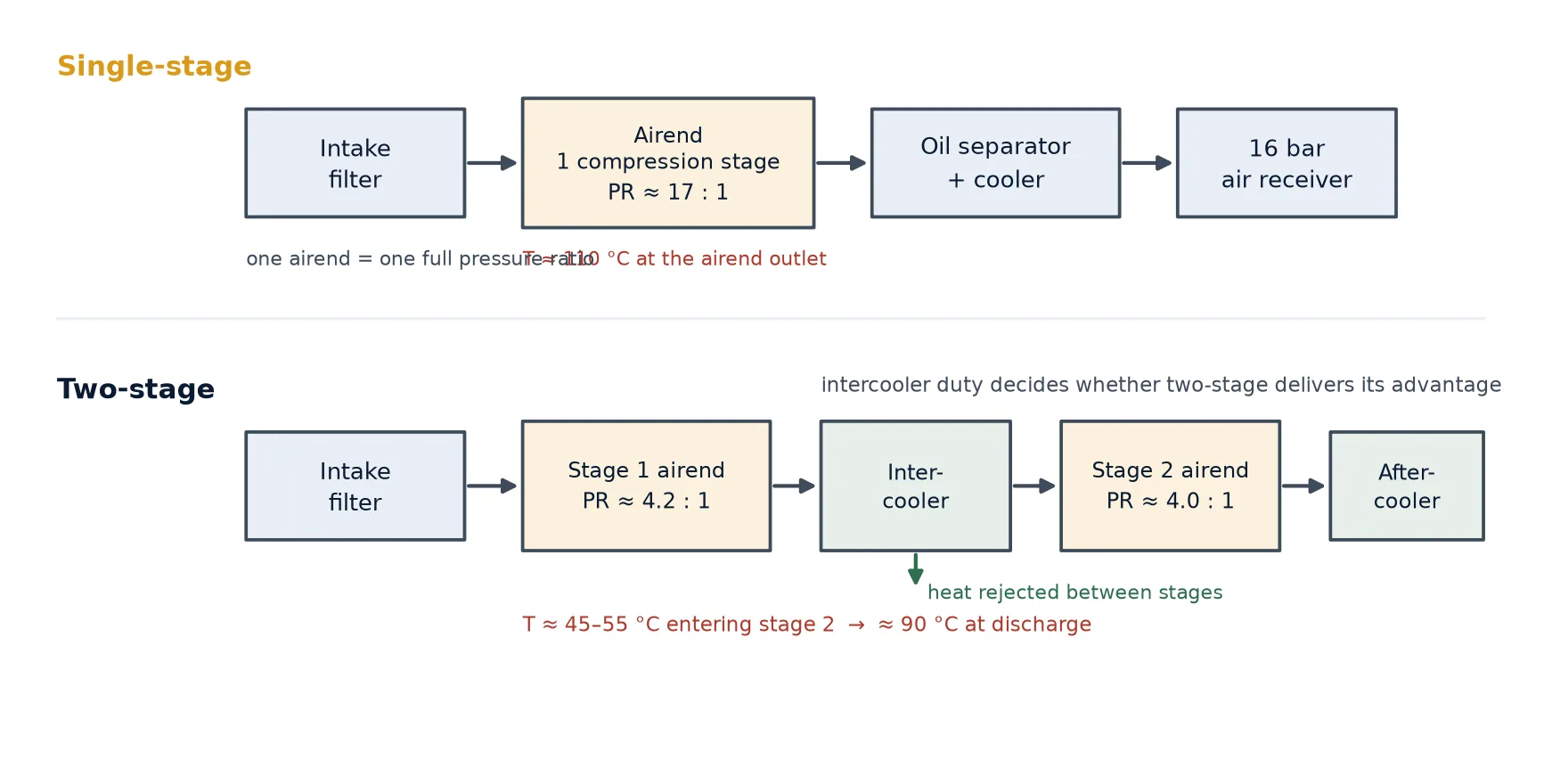
Pressure on a compressor datasheet is gauge pressure; compression works on absolute pressure. A machine rated at 16 bar gauge therefore lifts atmospheric air at 1.013 bar absolute to about 17 bar absolute, and the ratio it has to achieve in a single compression step is close to 17 : 1. That number, not the bar rating itself, is what the airend feels.
The consequences compound. Every increment of pressure ratio raises the temperature at the end of compression, raises the power absorbed per cubic metre delivered, and increases the axial and radial loads the rotor bearings carry. A machine that is comfortable at 8 bar (ratio 9 : 1) is doing roughly twice the compression work per cubic metre at 16 bar, and the airend that was designed around the lower ratio is now running at the edge of its thermal and mechanical envelope.
How the two architectures divide that ratio, and where each is the sensible buy, is set out in our comparison of single-stage and two-stage rotary screw compressors. The hardware itself is described on the two-stage rotary compressor and single-stage rotary compressor pages.
| Discharge pressure (gauge) | Absolute ratio | Indicative specific power, single-stage | Indicative specific power, two-stage |
|---|---|---|---|
| 8 bar | ≈ 9 : 1 | ≈ 5.6 kW per m³/min | ≈ 5.3 kW per m³/min |
| 10 bar | ≈ 11 : 1 | ≈ 6.2 kW per m³/min | ≈ 5.8 kW per m³/min |
| 13 bar | ≈ 14 : 1 | ≈ 7.1 kW per m³/min | ≈ 6.4 kW per m³/min |
| 16 bar | ≈ 17 : 1 | ≈ 8.3 kW per m³/min | ≈ 7.3 kW per m³/min |
Indicative ranges for oil-flooded rotary screw machines at 25 °C ambient; the real figures come from the data sheet of the machine you are buying. The point of the table is the trend, not the decimal places.
The four limits that decide the architecture
Four physical limits, not marketing, separate a machine that survives at 16 bar from one that does not. Any of them can force two-stage compression even at modest power.
- Discharge temperature. Oil-flooded airends are normally held below about 100–110 °C at the discharge port. Above that, the oil oxidises faster, varnish forms on the rotors and the separator element sees a harsher duty. A single-stage airend at 17 : 1 in a 40 °C ambient will sit near that ceiling at full load, and there is no reserve left for a hot afternoon or a fouled cooler.
- Bearing and rotor loads. Bearing life falls steeply as the pressure ratio rises, because both the axial thrust on the discharge side and the radial load increase. On larger airends the rotors themselves deflect more, which opens the clearance between the flanks and quietly costs volumetric efficiency.
- Specific power. Compression work per cubic metre grows with the logarithm of the pressure ratio, so the same delivered volume costs progressively more energy. Splitting the ratio into two stages and removing heat between them recovers a meaningful part of that loss.
- Oil life and separation. Higher discharge temperature shortens oil life and raises carry-over, and carry-over is what eventually reaches the dryer and the process.
Where the crossover actually sits
Field practice, and the product ranges most airend makers publish, put the crossover in a fairly narrow band. The table below is the one to keep in mind when a quotation arrives with a single-stage machine at 16 bar and you need to judge whether it is a clever design or a compromise.
| Motor power at 16 bar | Practical architecture | What decides it |
|---|---|---|
| 7.5 – 22 kW | Single-stage is normal | Air demand is small, airend load stays low, a generously sized cooler is enough |
| 30 – 45 kW | Genuine either-way band | Ambient temperature, duty cycle, and whether the machine will run at full load for long stretches |
| 55 – 90 kW | Two-stage is the default | Single-stage would run at the discharge temperature ceiling and lose 10 % or more specific power |
| 110 kW and above | Two-stage, usually with intercooling | Bearing and rotor loads make single-stage impractical at this ratio |
In two-stage machines the intercooler is the whole story
Two-stage compression is not automatically more efficient. The gain comes from removing the heat of the first stage before the air enters the second, because compressing hot air costs more than compressing cold air. If the intercooler is undersized, fouled or fed with 40 °C cooling water, the second stage starts from a high temperature, the discharge temperature climbs back toward the single-stage figure, and the theoretical advantage evaporates while the mechanical complexity stays.
On a 16 bar machine the two stages typically split the ratio fairly evenly — around 4.2 : 1 followed by 4.0 : 1 with the intercooler drop in between — which keeps both airends in a comfortable thermal band. That is also why interstage temperature, not just final discharge temperature, belongs on the specification: it is the number that tells you whether the cooler is doing its job in year three, not just at commissioning.
Where cooling is marginal, the honest options are a larger cooler, a water-cooled machine, or a lower ambient rating. Buying a bigger airend to compensate for a hot intercooler is the most expensive way to solve the problem.
Ambient and duty cycle: the derating arithmetic
Datasheets are usually written at 25 °C ambient and 1 bar. A machine installed in a 40 °C plant room, at 1,500 m altitude, on a supply that sags below nominal voltage, will not deliver the printed free air delivery. Three corrections matter at 16 bar because the machine has the least margin:
- Temperature. Intake air above the rated ambient reduces mass flow for the same swept volume, and it also raises every downstream temperature.
- Altitude. Lower atmospheric pressure means a lower absolute starting point, so the machine works harder to reach 16 bar gauge and delivers less standard-volume air.
- Voltage and frequency. A motor at 90 % of nominal voltage draws more current for the same shaft power; at 16 bar the margin against the service factor is thinner than at 8 bar.
Duty cycle matters just as much. A machine that runs 4,000 hours a year at full load is a different purchase from one that runs 800 hours in short bursts. In the first case, specific power dominates the lifetime cost and two-stage compression pays for its extra hardware. In the second, first cost and simplicity dominate, and a single-stage machine with a good cooler is often the more sensible engineering answer — even though it is the less impressive datasheet.
What to put on the RFQ for a 16 bar machine
Most of the avoidable mistakes at this pressure are specification mistakes, not manufacturing mistakes. Ask for these, in writing, and compare the answers rather than the headline kilowatt rating:
- Free air delivery in m³/min or CFM at 16 bar, with the ambient and altitude conditions stated.
- Specific power in kW per m³/min, or energy consumption per cubic metre, at the same conditions.
- Number of compression stages, and the pressure ratio of each.
- Interstage temperature and final discharge temperature at rated ambient.
- Cooling method, cooling air or water flow, and permitted cooling water inlet temperature.
- Motor insulation class, service factor, and the voltage and frequency actually available on site.
- Control type, and for a variable-speed machine the turndown range and minimum stable speed.
- Noise level at 1 m, and the footprint including cooler clearance.
- Which protections are fitted: high discharge temperature, high pressure, phase sequence, overload.
If two quotations differ by more than a few percent on specific power at the same pressure and the same ambient, the difference is real and worth understanding before it is negotiated away.
For a worked selection at a specific duty, the product and solutions overview is a faster starting point than a generic catalogue, and the contact page reaches the engineering desk directly.
Applications where 16 bar is genuinely required
It is worth confirming that the pressure is real before designing around it. Some processes do need it: certain laser cutting installations use assist air in the 10–16 bar range where nitrogen or bottled gas is not wanted, some pneumatic conveying and injection systems are specified at 12–16 bar to overcome line losses, high-pressure leak testing and some machine-tool clamping circuits run there, and offshore and mobile equipment often carries a single high-pressure machine instead of two.
Other enquiries turn out to be 10 bar jobs with a safety factor added at every stage. Where that is the case, dropping to 10 bar is usually worth more than any choice between architectures — every bar of discharge pressure costs roughly 6–8 % of the energy for the same delivered volume, so an unnecessary 6 bar is a permanent tax on the compressed-air budget.
Where the high pressure exists to serve a cutting process rather than a general plant, our note on high-pressure air compressors for laser cutting covers the assist-air side in more detail.
Common specification mistakes
- Quoting FAD at 7 bar for a 16 bar requirement. The same machine delivers noticeably less air at 16 bar; compare like with like.
- Sizing on nameplate kilowatts. Two machines of the same motor power can differ by 10 % in delivered air at 16 bar.
- Ignoring the plant room. A high-pressure machine in a hot, poorly ventilated room loses the advantage that justified it.
- Forgetting the dryer and receiver. At 16 bar the same mass of air holds more water, and the downstream equipment has to be rated for the pressure, not just the flow.
- Buying turndown that will never be used. A variable-speed drive on a machine that runs at full load all year adds losses rather than savings.
Frequently asked questions
Can a single-stage screw compressor deliver 16 bar?
Yes, and many do, particularly in the smaller power bands. The question is not feasibility but margin: at ratio 17 : 1 the airend runs close to its discharge temperature limit and its bearings carry a heavy load, so the design has to be generous in cooling and conservative in rating. Above roughly 45–55 kW, two-stage compression is normally the better engineering choice.
How much energy does two-stage compression save at 16 bar?
Typically in the region of 8–15 % specific power compared with a single-stage machine of the same duty, provided the intercooler is sized and maintained properly. The saving is not a fixed property of two-stage hardware; it is a property of how well the interstage heat is removed.
Does 16 bar always mean a two-stage machine is worth the extra cost?
No. If the machine runs a few hundred hours a year in short bursts, the energy saving may never repay the additional airend, intercooler and control complexity. The decision is driven by annual running hours at load, which is why a load profile is more useful than a pressure rating alone.
What discharge temperature should I expect at 16 bar?
On a well-cooled oil-flooded machine, roughly 85–95 °C at the airend discharge at rated ambient. If a quotation implies sustained operation above about 105–110 °C, ask where the margin comes from on a 40 °C day, because that is when the machine will actually be working.
Is water cooling necessary at this pressure?
Not necessarily, but air cooling has less headroom at 16 bar than at 8 bar. In a hot climate, or where the machine sits in a small room with recirculating air, water cooling or a ducted air path is often the difference between a stable machine and one that trips on high temperature in summer.
How does pressure affect the air dryer and receiver?
Higher pressure means each cubic metre of free air holds more water vapour once compressed, and the dryer, filters and receiver all have to be rated for 16 bar rather than 10 bar. It is common to see a well-chosen compressor paired with downstream equipment specified for the lower pressure; that mismatch is worth checking before the order is placed.
Answers apply to oil-flooded rotary screw machines; site-specific limits always come from the manual of the unit in question.
Specifying a 16 bar machine for a real duty?
Send us the pressure, the required free air delivery, the ambient conditions and the annual running hours. We will come back with the architecture that fits, single-stage or two-stage, and the numbers behind the recommendation.