

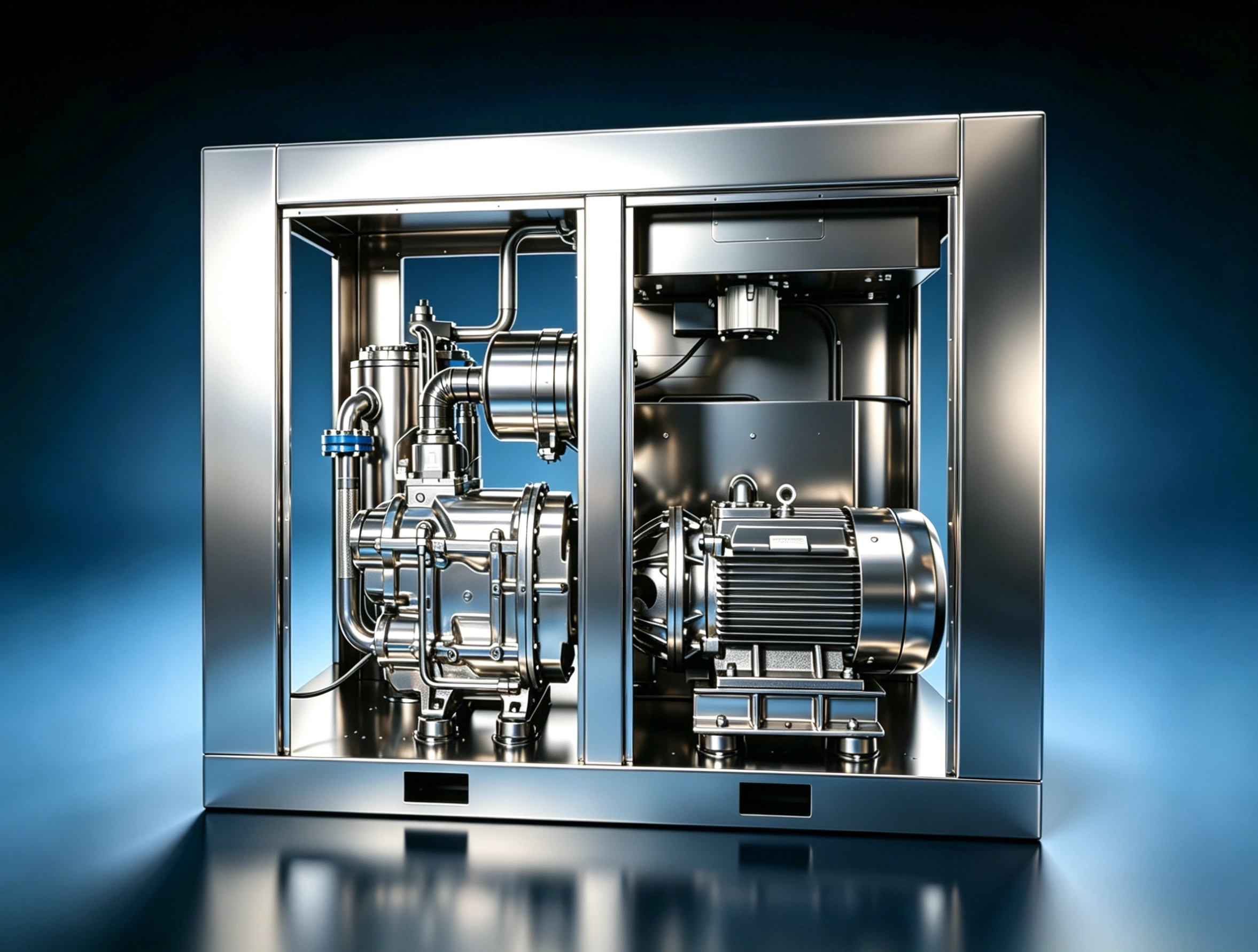
Single-stage or two-stage? It depends on how the machine runs, not on the brochure
Almost every compressed-air project reaches the same fork in the road: buy a proven single-stage rotary screw compressor, or pay more up front for a two-stage machine that promises lower energy bills. Both answers can be right. The deciding factors are the pressure you actually need, how many hours a year the machine runs, and how close to full load it will sit.
This guide walks through what a stage really is, what changes when you add a second one, and how to tell which route fits your plant — without the marketing language.
What “stage” actually means
In a rotary screw airend, air is squeezed between two meshing rotors. Every time the airend compresses from atmospheric pressure up to your working pressure in a single step, that is one stage.
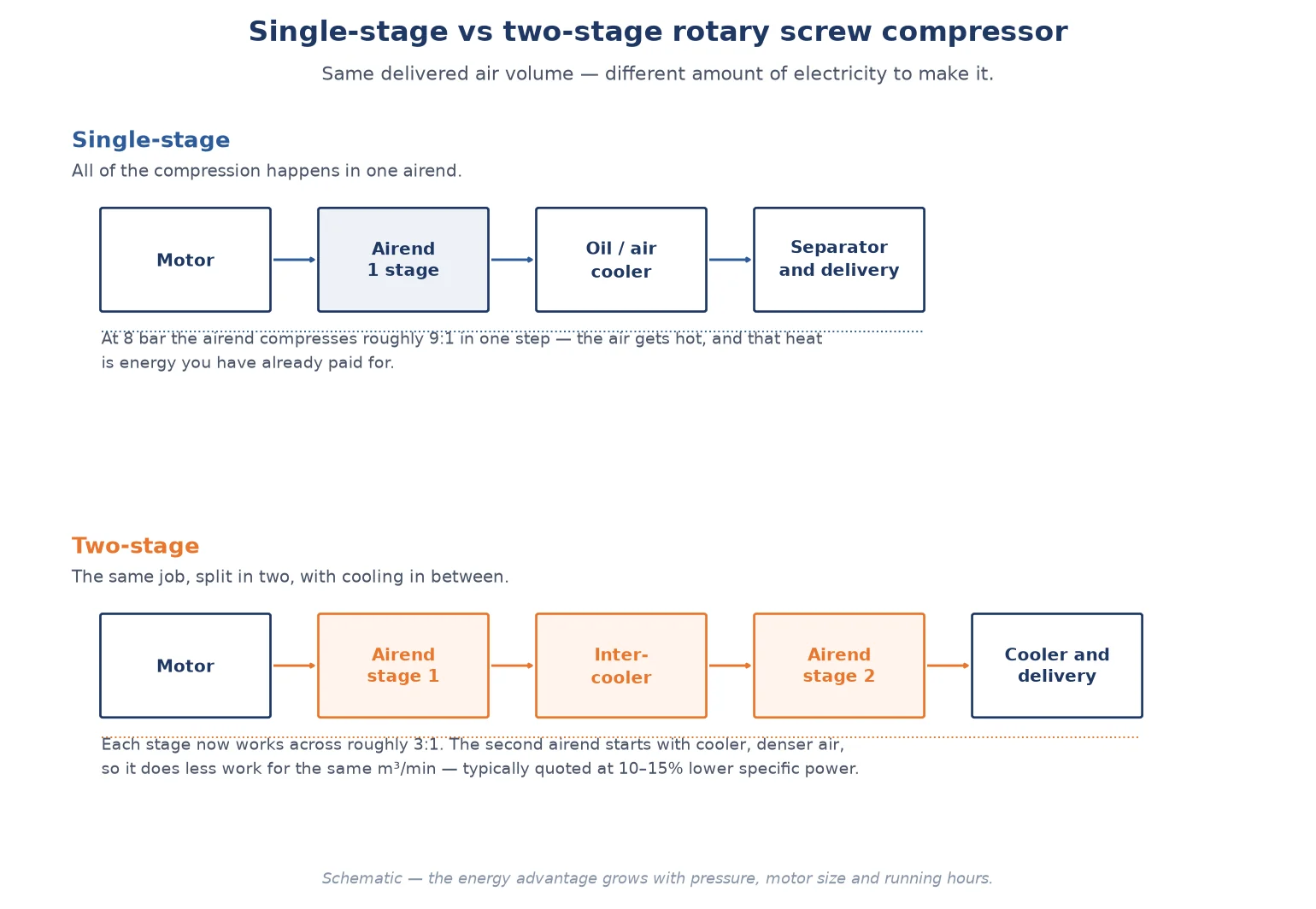
Compression heats the air. In a single-stage machine the oil injected into the airend absorbs that heat and carries it to the cooler — the discharge temperature sits around 80–95 °C, and the heat is a by-product you have to remove.
A two-stage machine splits the same job in half. The first airend compresses to an intermediate pressure, the air passes through an intercooler, and a second airend finishes the job. Because each stage works across a smaller pressure ratio, the air leaves the second stage cooler and the whole process needs less energy for the same delivered volume.
Single-stage: the default for most workshops
A single-stage screw compressor is simpler, cheaper to build and cheaper to maintain. One airend, one set of bearings, one oil circuit that is already doing the cooling. For the great majority of industrial users — a workshop at 7 or 8 bar, a machine at 10 bar feeding a blasting or packaging line — it does the job at the lowest total cost.
The engineering has also improved a lot. Modern rotor profiles, tighter clearances and larger coolers mean a good single-stage machine at 8 bar still delivers a competitive specific power, and the working parts are well understood by any service technician.
You can see the current range and the pressure bands we build for on our single-stage rotary screw compressor page.
Two-stage: the same air, less electricity
Adding the second stage is not just “more airend”. It changes the shape of the whole machine:
- Lower compression ratio per stage — less internal leakage and better volumetric efficiency.
- Intercooling between stages — the second airend starts with cooler, denser air, so it does less work.
- Cooler discharge air — which means less heat load on the oil cooler and often longer oil life.
- A bigger footprint and a bigger price tag — two airends, an intercooler, more piping, more oil.
Two-stage machines are usually built in larger sizes, typically from around 55–75 kW upward, and they are at their best at higher pressures (10 bar and above) and near-continuous duty.
Our two-stage rotary screw compressor range covers those larger, high-pressure duties.
The energy argument, in plain numbers
Compressed air is one of the more expensive utilities a plant buys, and the compressor is where most of that cost is created. Industry figures for two-stage machines commonly quote a specific power improvement in the region of 10–15% over an equivalent single-stage unit at the same pressure — the exact number depends on size, pressure and how the machine is regulated.
Run that against a real duty cycle:
| Item | Example |
|---|---|
| Motor size | 75 kW |
| Loading | 80% average (typical of a healthy system with storage) |
| Running hours | 6,000 h per year |
| Energy at the shaft | 75 kW × 0.8 × 6,000 h ≈ 360,000 kWh per year |
| 12% specific power improvement | ≈ 43,000 kWh saved per year |
Whether that saving repays the extra purchase price is a payback calculation, not a rule of thumb. At one shift a day the payback stretches out. At three shifts, seven days a week, it can be remarkably short. This is the single most useful number to calculate before choosing.
Where each type usually lands
| Duty | Typical choice |
|---|---|
| Up to 45 kW, 7–10 bar, one or two shifts | Single-stage, fixed speed or VSD |
| 45–75 kW, 7–8 bar, continuous | Either — compare payback case by case |
| 75 kW and above, 10 bar or higher, near-continuous | Two-stage |
| Very high pressure (16–40 bar) | Specialist high-pressure machines |
Where a plant’s demand swings a lot during the day, the control strategy can matter more than the number of stages. A variable-speed drive on a single-stage machine often beats a fixed-speed two-stage machine on a lightly loaded system.
When single-stage is the right answer
- Pressure demand is 7–10 bar and power is below roughly 55 kW.
- The machine works one or two shifts, so energy saving has fewer hours to pay back against.
- Floor space or budget is tight.
- You want the simplest service story: one airend, one common set of spare parts.
When two-stage pays back
- Running pressure is 10 bar or higher.
- Power is 75 kW or more and the machine is loaded most of the time.
- Electricity is expensive where you operate.
- You are replacing an ageing machine and want the running cost to drop, not just the reliability to improve.
Don’t forget everything around the airend
Two stages only help if the rest of the system lets them. Before spending the difference, check that:
- Leakage is under control — an unmanaged system can easily lose 20–30% of its output through leaks, which no machine choice will fix.
- Storage is adequate, so the compressor is not cycling on short, wasteful runs.
- Dryers and filters are sized for the real flow, not the nominal flow.
- The control system can sequence multiple machines instead of letting one unit carry the base load alone.
Two other routes worth knowing
Not every plant is choosing between one stage and two. If the air touches food, pharmaceuticals, electronics or breathing air, the question is oil: oil-free water-lubricated compressors deliver Class 0 air without an oil filter in the chain.
And if the machine has to move between sites — rental fleets, construction, remote drilling — the answer is mobility: see our portable rotary screw compressors. The full premium rotary screw compressor range covers all four families.
FAQ
Is a two-stage compressor always more efficient?
No. The advantage comes from intercooling and a lower pressure ratio per stage, and it grows with size, pressure and running hours. At small sizes or light duty, a well-designed single-stage machine with variable speed can be the more efficient installation.
Does two-stage mean two motors?
Usually one motor drives both airends through a gear or direct coupling. What changes is the airend arrangement, the intercooler and the piping — not necessarily the motor count.
How much floor space does two-stage need?
Expect a noticeably larger package than a single-stage machine of the same motor size, because of the second airend and the intercooler. Plan the layout before you commit.
Can I retrofit a stage onto an existing compressor?
Not practically. Two-stage is a different machine, not an add-on. If your demand has outgrown a single-stage unit, the realistic options are a correctly sized replacement or splitting the load across two machines.
Sizing a new compressor?
Send us the working pressure, the measured air demand in m³/min or CFM, the duty cycle and the power supply available on site. We will come back with the stage arrangement, the size and the control strategy that fits — and a clear explanation of why. Start at contact us.