
Oil-Free or Oil-Injected? Choosing Compression Technology for Class 0 Air
Choose oil-free when the air touches the product, the packaging or a patient, and when someone can produce a measurement rather than a brochure. Choose oil-injected when the air drives a cylinder, a tool or a conveying line and the specification allows up to 0.1 mg/m³ of oil. The decision is not about quality in the abstract: an oil-injected machine with a separator, a coalescer and a carbon bed can reach the same measured oil content as an oil-free machine on the day it is commissioned, and it can lose that performance the day a filter is skipped. Oil-free removes the failure mode instead of managing it, at the cost of specific power and, on water-lubricated designs, a water treatment routine.
What oil-free means in the standard, and why Class 0 is not a number
ISO 8573-1:2010 describes compressed air quality with three independent digits: particles, water and oil. The oil digit is the one that drives technology choice, and its classes are defined as total oil content in milligrams per cubic metre at the stated conditions: class 1 is 0.01 mg/m³, class 2 is 0.1, class 3 is 1 and class 4 is 5. Class 0 is different in kind. It has no fixed value: it means whatever the user and the supplier agree, measured at a defined point, and it must be better than class 1 to mean anything at all.
| ISO 8573-1 oil class | Oil content | What it is normally used for |
|---|---|---|
| Class 0 | Agreed, better than 0.01 mg/m³ | Food, pharma, medical, electronics, where the spec names it |
| Class 1 | ≤ 0.01 mg/m³ | Instrument air, breathing air with additional treatment |
| Class 2 | ≤ 0.1 mg/m³ | General plant air with coalescing filtration |
| Class 3 | ≤ 1 mg/m³ | Cylinders, tools, conveying where oil is tolerated |
| Class 4 | ≤ 5 mg/m³ | Rough service, no product contact |
The practical consequence: asking a supplier for a Class 0 machine is not a specification. Ask for the measured oil content at the point of use, the test method, the conditions and the maintenance that the figure depends on. A certificate that quotes Class 0 without those four items is marketing, and an auditor will treat it that way.
Where the oil in an oil-injected machine ends up
An oil-injected element injects oil into the compression chamber for sealing, cooling and lubrication. Most of it is knocked out mechanically in the separator vessel, and the rest leaves as an aerosol that the filtration train has to catch. Typical residual figures after each stage, on a well-maintained machine at 7 bar:
| Stage | Residual oil | What it depends on |
|---|---|---|
| Separator element only | 1–5 mg/m³ | Element condition, sump level, oil type |
| + coalescing filter | 0.1 mg/m³ | Filter grade, drain function, differential pressure |
| + carbon adsorber | 0.01 mg/m³ achievable | Carbon life, inlet temperature, saturation |
| Oil-free element | No oil in the compression chamber | Seals and bearings are isolated; water or air is the lubricant |
That table explains both the appeal and the risk of the oil-injected route. The filtration train genuinely works, and on a plant with disciplined maintenance it delivers instrument-quality air for years. But it is a chain: a filter changed late, a drain stuck open, a separator element ruptured, and oil reaches the product. Oil-free does not depend on that chain. It also does not remove the need for dryers, filters or monitoring; it removes one specific failure path.
The oil-free technologies compared
Oil-free is not one machine. The three families behave differently enough that the choice between them matters as much as the choice against oil injection.
| Technology | Pressure range | Discharge temperature | Relative specific power | Notes |
|---|---|---|---|---|
| Two-stage dry screw | up to 13 bar, high volume | 150–200 °C per stage without internal cooling | 110–125 | Timed rotors, no contact, coatings; heat is easy to recover |
| Single-stage water-lubricated screw | up to 13 bar, small to medium | 50–60 °C | 105–112 | Stainless rotors, RO water, water pump and treatment routine |
| Scroll and tooth designs | up to 10 bar, small flows | Moderate | 115–130 at small sizes | Oil-free by geometry; limited turndown |
| Centrifugal | above roughly 250 kW | Low | 100–110 at design point | Narrow stable range, surge protection needed |
For most plants under 200 kW the real choice is between a two-stage dry screw and a water-lubricated single-stage machine. The dry screw wins on simplicity of the working chamber and on high-pressure duty; the water-lubricated machine wins on part-load behaviour and on discharge temperature, which makes both the machine and the room easier to live with. Both are true oil-free designs: no oil enters the compression chamber in either.
Four gates, in this order
Selections go wrong when the technology is chosen before the duty is understood. Run these four gates in order and most of the decision makes itself.
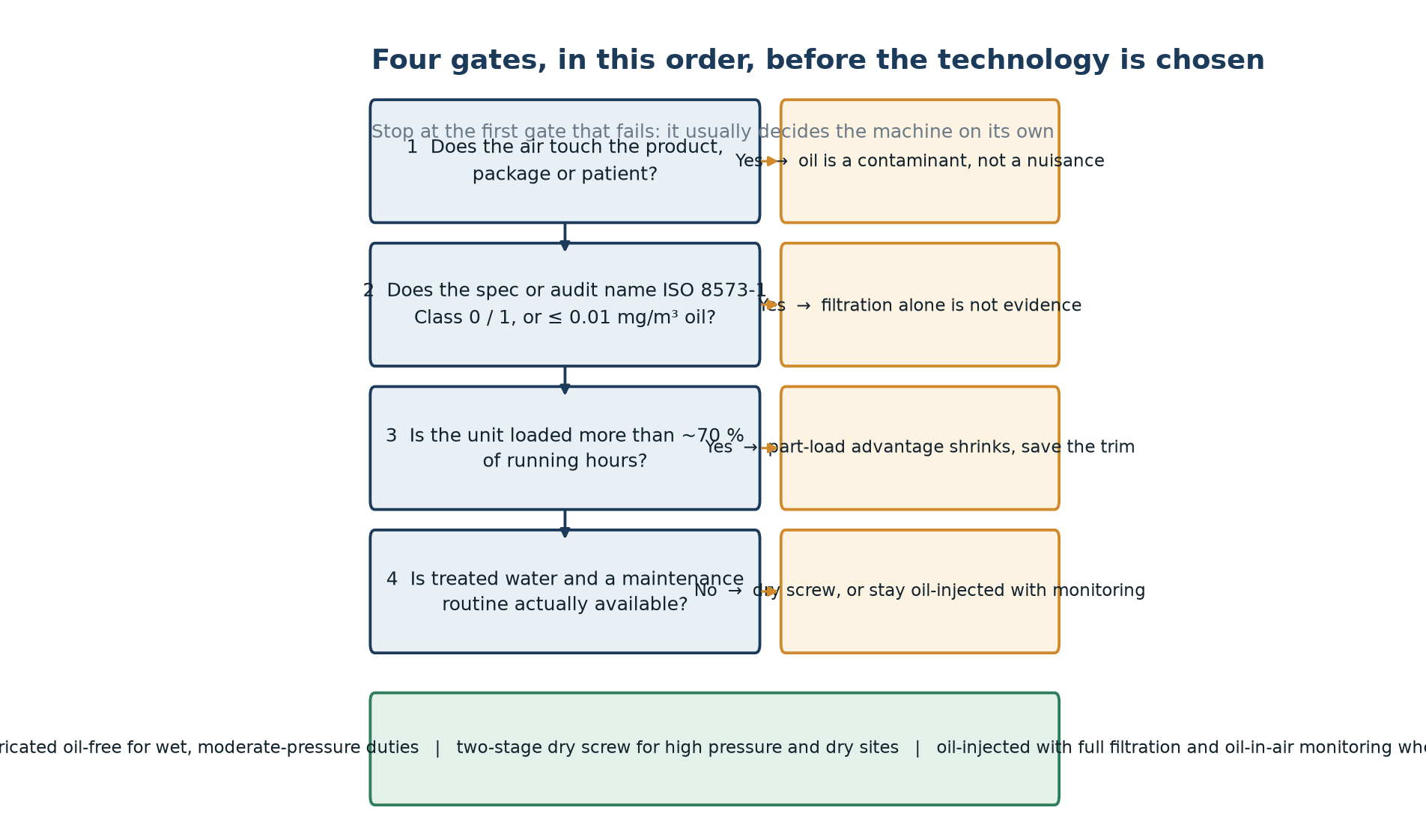
- Does the air touch the product, the packaging or a patient? If yes, oil is a contaminant rather than a nuisance, and the burden of proof moves to the oil-injected option.
- Does the specification or the audit name Class 0 or Class 1? If the figure is written into a customer requirement, a certificate or a validation protocol, filtration alone rarely satisfies it, however good the measured result.
- Is the unit loaded more than about 70 % of running hours? Heavily loaded machines narrow the part-load advantage of a water-lubricated design, and a dry screw at steady full load is hard to beat on simplicity.
- Is treated water and a maintenance routine actually available? A water-lubricated machine needs RO-quality water, a water circuit that is checked, and someone who will do it. Without that, a dry screw or a well-instrumented oil-injected machine is the more honest answer.
What the specific-power penalty looks like
Oil-free designs give up some efficiency, and pretending otherwise loses credibility with any technical buyer. The penalty comes from clearances that cannot be sealed with oil, from higher internal temperatures on dry screws, and from the auxiliary power of water pumps and treatment. Expressed as an index with a modern oil-injected VSD machine at 100:
| Design | Full load | 40 % load with VSD | Comment |
|---|---|---|---|
| Oil-injected, VSD | 100 | 103–108 | Baseline; part-load behaviour is good |
| Water-lubricated oil-free, VSD | 105–112 | 108–115 | Water injection keeps compression cool |
| Two-stage dry screw, VSD | 110–125 | 125–140 | Turndown limited by temperature and rotor cooling |
| Fixed-speed any design | 100 at design point | 125–145 | Why VSD dominates part-load duties |
An index is not a bill, but the direction is reliable: at 40 % load for long hours, the gap between a VSD oil-injected machine and a VSD dry screw can be worth more than the filtration train the oil-free option was meant to avoid. That is why gate 3 exists. On a site that runs two shifts at high load, the penalty is small and the risk reduction is worth it. The energy behaviour behind these numbers is the same one described in part-load kWh savings on VSD compressors.
Water quality and the maintenance routine
A water-lubricated machine circulates treated water through the compression chamber, so water quality is a wear item. Conductivity and hardness have to stay inside the manufacturer’s window, the water filter and the water pump are scheduled parts, and the cooling circuit must be able to hold temperature in a hot room. Get this right and the machine is as reliable as anything else in the plant; treat the water circuit as an afterthought and the rotor coating becomes the maintenance budget.
Dry screw machines avoid the water circuit and inherit a different set of habits: coating condition, clearance checks at overhaul, inlet air quality and, above all, a stable cooling supply. Their discharge temperatures are high by design, which makes heat recovery attractive and also makes a cooling interruption serious. Either way, the oil-free claim covers the compression chamber only; the dryer, the filters and the separators upstream and downstream still decide the air quality at the point of use.
Mistakes that decide the project wrongly
- Buying Class 0 without a measurement point. The class is worthless unless the sample point, the method and the frequency are defined.
- Assuming oil-free means clean air. Particles, water and pipe scale do not disappear; a dryer and a filter still belong in the system.
- Forgetting the part-load penalty. A dry screw at 40 % load can consume more than a VSD oil-injected machine at the same duty.
- Buying water-lubricated without a water plan. No RO supply, no routine, and the savings go into repairs.
- Treating filtration as a one-off purchase. The oil-injected route is only defensible with scheduled filter changes and differential pressure monitoring.
How the decision usually lands
Food, beverage, pharmaceutical, medical and semiconductor plants end up oil-free, and the specification usually names Class 0 or Class 1 with a documented measurement point. General manufacturing, workshops, packaging without product contact and construction sites end up oil-injected, with a dryer and a filtration train matched to the class the process actually needs. The middle ground, where the process is sensitive to oil but the specification does not name a class, is decided by the cost of a contamination event rather than by the compressor.
One more consideration that is easy to miss: site conditions. Altitude, ambient temperature and voltage deviation affect both designs, but they affect them differently, because a dry screw has less thermal headroom and a water-lubricated machine depends on its cooling circuit. The corrections are set out in how site conditions cut delivered air flow, and they should be applied to whichever design is chosen before the size is fixed.
Where the duty sits above about 16 bar, or where the process needs high pressure at modest flow, the compression architecture changes before the lubrication question does; that case is covered in when 16 bar requires two-stage compression. And where the machine is large, heavily loaded and expected to run for a decade, the durability questions in heavy-duty VSD machines around 132 kW matter more than the last percentage point of specific power.
Frequently asked questions
Can an oil-injected compressor meet Class 1?
It can, with a coalescing filter followed by a carbon adsorber, on the day the elements are new and the drains work. The figure depends on maintenance, which is exactly the difference from an oil-free machine: one achieves the class by treatment, the other by removing the oil from the compression chamber.
Is Class 0 better than Class 1?
Class 0 must be better than Class 1 by definition, but it is an agreed value with no fixed number. Two suppliers can both claim Class 0 with different measured oil contents. Always ask for the number, the method and the sample point.
Do I still need an air dryer with an oil-free compressor?
Yes. Oil-free says nothing about water. The pressure dew point you need determines the dryer type, and that decision is independent of the lubrication principle. See dryer selection by pressure dew point.
How much more energy does an oil-free machine use?
Typically 5 to 12 % more specific power at full load for a water-lubricated machine, and 10 to 25 % more for a two-stage dry screw, with the gap widening at part load. The exact figure depends on size, pressure and control.
Is water-lubricated oil-free suitable for high ambient sites?
It can be, but the cooling circuit and the water treatment become critical, and the machine’s rated conditions have to be checked against the site. On very hot, dry sites with unreliable water supply, a dry screw is often the more robust oil-free choice.
What maintenance does the oil-free claim depend on?
On the intake filter, the cooler, the condensate drains and, for water-lubricated units, the water circuit. The compression chamber has no oil to change, but the system around it still has a schedule.
Answers apply to oil-flooded rotary screw installations with standard filtration; site-specific limits always come from the manual of the unit supplied and from the process standard for the application.
Need the class, not the label?
Tell us the process, the oil content the specification actually names and the load profile. We will come back with the technology, the treatment train behind it and the measurement point that makes the claim verifiable.