
Almost every variable-speed air compressor is sold on a saving percentage, and almost every one of those percentages is measured at a load point the site may never reach. The honest position is simple: a variable-speed drive saves energy only where the air demand is genuinely variable, and the size of the saving is a calculation, not a claim. Done properly it takes one week of data logging and one page of arithmetic. Done badly it produces a number that looks convincing and never appears on the electricity bill.
This article sets out the calculation in the order it should be done, shows a worked example at 60–70 % average load, and lists the cases where a VSD machine saves nothing at all.
Start with specific power, not kilowatts
Compressors are compared on specific power: the input power needed to produce one unit of delivered air, expressed either as kWh per m³ or as kW per m³/min. A machine that delivers more air for the same input power is more efficient regardless of what its motor nameplate says, and a machine with a lower nameplate rating can easily be the thirstier of the two at the pressure you actually run.
Three rules make the number comparable. First, measure at the real discharge pressure, because specific power rises by roughly 6–8 % per additional bar. Second, use input power at the terminals — including the drive, the fan and the controller — not shaft power. Third, confirm the free air delivery, ideally with a nozzle or flow test, because datasheet figures are written at a reference ambient that may not match your plant room.
| Measurement | Why it matters |
|---|---|
| Input power, kW at the terminals | Includes drive and fan losses; the only figure the utility bills you for |
| Free air delivery, m³/min | Denominator of the calculation; verify rather than assume |
| Discharge pressure, bar | Specific power changes with every bar; compare at the same pressure |
| Running and idle hours | Load/unload machines burn power while producing nothing |
What a fixed-speed machine really does at part load
A fixed-speed screw compressor running load/unload does not throttle down. It runs at full speed and full displacement until the receiver reaches the upper set point, then it closes the inlet valve and idles, then it loads again. At 60 % average demand the machine is typically loaded 60–70 % of the time and idling the rest, and while idling it still draws somewhere between 20 and 35 % of full-load power to keep the oil circulating and the airend turning.
That idle power is what destroys part-load efficiency. The delivered air falls by 40 % while the consumed power falls by much less, so the effective specific power climbs steeply as demand drops — often doubling by the time the machine is averaging a third of its capacity. Short cycling makes it worse: every unload period that lasts less than a minute or two is largely wasted, and a receiver that is too small guarantees exactly that.
Two mechanical alternatives exist. A machine with a slide or spiral valve can reduce displacement at fixed speed and holds efficiency better than plain load/unload, and a machine with a variable-speed drive reduces speed instead of stopping the air. Both help; the drive has the wider range.
If the machine has to work in a hot, dusty or high-altitude plant room, the derating effects described in our article on compressors for harsh sites shift the part-load numbers as much as the choice of drive does.
What the drive actually delivers
A VSD machine matches displacement to demand by slowing the airend, so at 60 % demand it consumes roughly 60 % of the power rather than 60 % of the air with 75 % of the power. Modern permanent-magnet motors keep efficiency high across the speed range, which is why the part-load curve stays comparatively flat between about 40 % and 100 % of capacity.
The limit is turndown. Below some minimum speed — commonly 20–30 % of maximum — the airend cannot build enough pressure to maintain oil circulation effectively, so the machine either stops and restarts or falls back to load/unload at low speed. On a machine that is oversized for its load, average demand can sit permanently below that minimum, and the result is a drive that cycles rather than modulates. This single mistake accounts for a large share of VSD installations that never deliver the promised saving.
The calculation, step by step
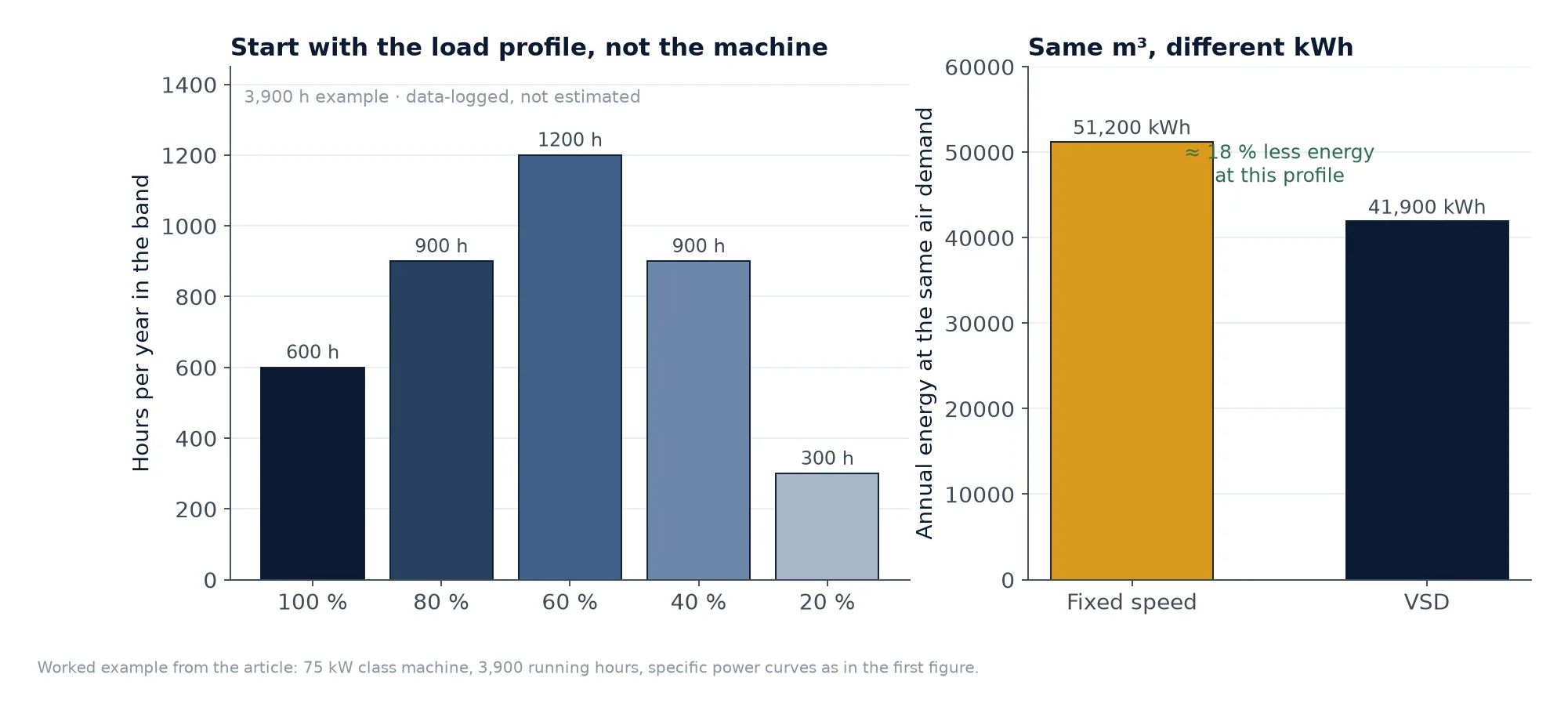
Take a 75 kW class machine, 16 bar site pressure, single machine supplying a plant that runs 3,900 hours a year. Log the delivered air for two weeks, build a load profile, and extrapolate to the year.
When the drive saves nothing
There are four situations where a VSD machine is the wrong purchase, and they are common enough to check first:
- Continuous full-load duty. If the plant consumes everything the machine can produce all year, the drive only adds conversion losses and a maintenance item. Sequencing a fixed-speed machine into a base-load role is cheaper and slightly more efficient.
- Oversizing. A VSD machine whose minimum stable output is above the plant’s typical demand will cycle, and cycling gives back most of the theoretical gain.
- Loads that step, not slide. If demand jumps between two fixed values hours apart, a drive spends its life at two points and a smaller fixed-speed machine with a correctly sized receiver may do as well.
- Power quality problems. Drives bring harmonics and a lower power factor at partial load. On a weak supply or a small generator, that has to be engineered for rather than discovered.
There is also the honest limit of any calculation: a saving that depends on future production levels is an assumption, not a measurement. If the plant’s demand is expected to grow, it can be better to buy the base-load machine now and add variable-speed trim capacity later, when the profile is known.
The same reasoning applied to a large heavy-duty unit is set out in the heavy-duty VSD efficiency guide; the machine options themselves sit on the two-stage and single-stage product pages.
Measure instead of guessing
A one-week logging campaign costs far less than a wrong compressor and settles the argument. What to record:
- Input power at the machine terminals, at one-minute intervals, for at least seven days including a full production week.
- Discharge pressure and, if available, flow, on the same time base.
- Load and idle state, which most controllers can log or output as a volt-free contact.
- Ambient temperature in the plant room, because a July profile is not a January profile.
From that data, build a histogram of delivered air and compute the band-by-band energy with each candidate machine’s curve. If the site already has two machines, log the sequencing as well: how the units share load often matters more than which drive they carry.
Sizing rules that protect the saving
- Size a VSD machine to the average demand, not to the peak; use a fixed-speed machine for peaks and let the two sequence together.
- Keep the average demand at least one full band above the minimum stable output — commonly 25–30 % of rated capacity.
- Give the receiver enough volume that pressure changes are slow compared with the drive’s response; a small receiver turns a good drive into a cycling machine.
- Set the pressure band narrow on the VSD unit and let it lead; the fixed-speed unit should sit above it as trim.
- Specify a minimum turndown figure in writing, and ask for the specific power curve across the whole range, not a single point.
These are cheap decisions at the specification stage and expensive ones afterwards.
More selection and maintenance notes are collected on the blog index.
Frequently asked questions
How much energy does a VSD air compressor really save?
It depends on the load profile, not on the drive. Where average demand sits between 40 % and 70 % of capacity and the load genuinely fluctuates, savings of roughly 15–30 % of compressor energy are common against a load/unload machine. At continuous full load the saving is negative, because the drive adds losses.
Is a permanent-magnet motor necessary for part-load efficiency?
It helps. Permanent-magnet motors hold efficiency better at low speed than induction motors, so the part-load curve stays flatter. The gain is real but secondary to correct sizing — an oversized permanent-magnet machine still cycles, and a well-sized induction VSD machine still performs.
What is turndown and why does it decide the saving?
Turndown is the range between minimum stable output and maximum output. If the plant’s average demand falls below the minimum stable output, the machine cannot modulate and reverts to starting and stopping, which erases much of the advantage. Check the minimum figure against the logged average demand before ordering.
Can I estimate the saving without logging data?
You can produce an estimate from production records and existing compressor run hours, and it is a reasonable first pass. It is not a substitute for measurement when the decision involves significant capital, because unload time and short cycling are almost always worse in reality than in the estimate.
Do I still need a receiver with a VSD machine?
Yes, and often a larger one. The drive responds quickly to pressure changes, and a small receiver makes the pressure signal noisy, so the machine hunts. Adequate storage also lets the drive run at a steady speed instead of chasing every demand spike.
Should I replace two fixed-speed machines with one VSD unit?
Usually the better move is a VSD lead machine with a fixed-speed unit as trim. One large VSD machine has to cover both the average and the peak, which pushes it toward oversizing; a two-machine arrangement keeps the drive in its efficient band and covers peaks without idling.
Answers apply to oil-flooded rotary screw machines; site-specific limits always come from the manual of the unit in question.
Have a load profile you would like checked?
Send us the logged flow and pressure data, or just the running hours and the production pattern. We will run the band-by-band calculation and tell you whether variable speed is worth it on your site — including when the answer is no.